
Recommendation To Charlotte Housing Committee
Email sent June 16, 2026
I believe that that you will be reviewing the city policy on use of the Housing Trust Fund. There are two classes of policy to consider. One is the 2024 policy of allocation of dollar amounts to aim for categories of housing out of the presumptive bond package of $125M. Presently you have an allocated $35M for new construction of rental housing, which is the only category that provides gap financing for Low Income Housing Tax Credits (LIHTC).
The other policy is the scoring system used to rank the competing proposals seeking awards from the HTF. That scoring grid tends to favor the proposals that produce the most units per dollars invested by the city, which, necessarily means that the proposals utilizing the least expensive land can generally produce a higher percentage of units. That has been the historical criterion that has had the largest influence on where LIHTC developments have been placed in Charlotte.
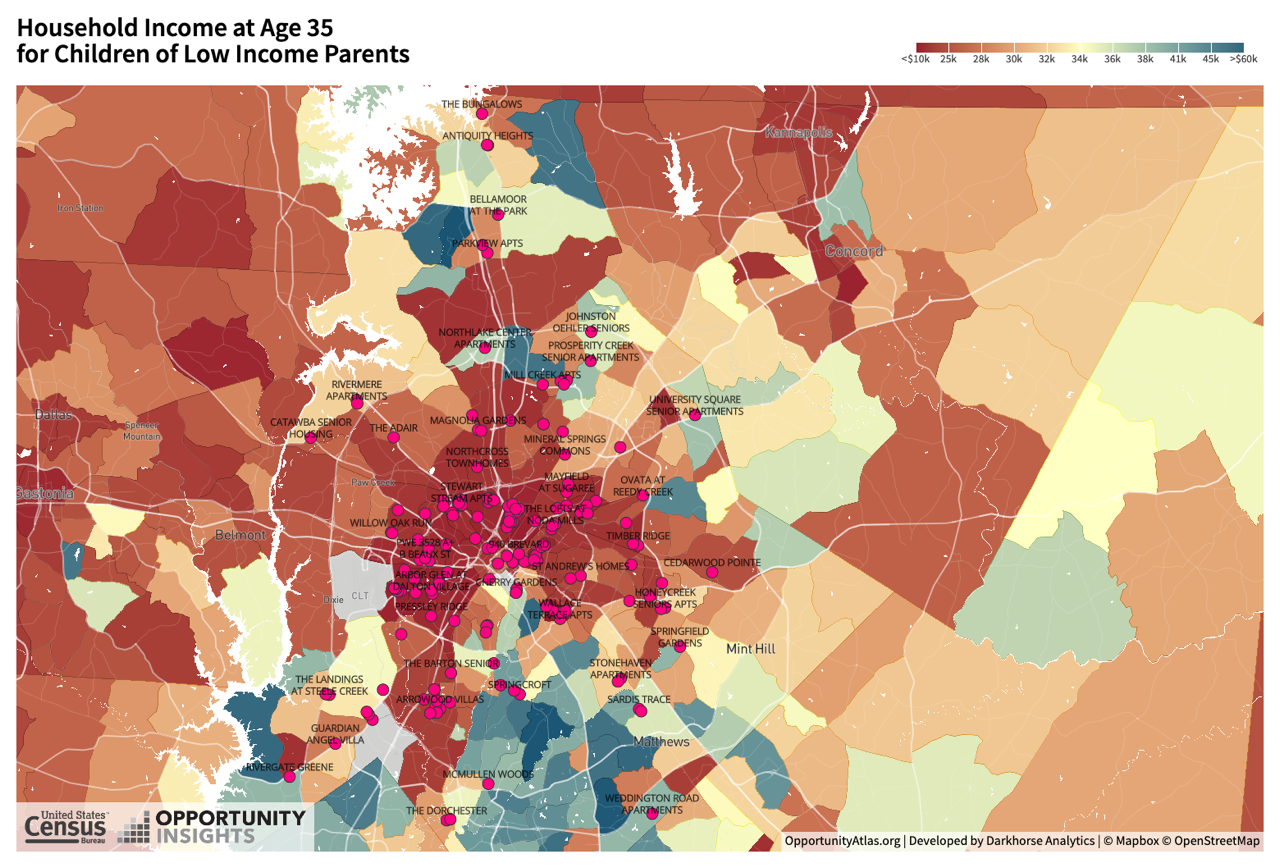
What is the result of this policy of rewarding the most units that city dollars can leverage? The best picture of the answer appears below. It is the map generated by Harvard Professor Raj Chetty when he studied the opportunity for upward mobility of children in the 50 largest metropolitan communities in the U.S. You will recall the media impact on Charlotte when the report showed that Charlotte ranked dead last in the nation. Chetty also concluded that the most significant factor in the negative mobility in Charlotte was the extreme racial and economic segregation of our community, which also coincided with the extremely segregated school system.
This map is a visual depiction of that pattern of segregation. Notice that the darker red areas are representing the concentrated poverty areas. The pink dots show the location of all of the LIHTC developments over the entire history of the program. It is easy to see how the LIHTC locations have perpetuated the economic and racial segregation in the community. Since LIHTC proposals are not economically feasible without gap financing form the HTF , this pattern also says that the city has a key role in determining where tax credit units are built by the scoring criteria employed. If the city continues to favor proposals that will generate the most units—by utilizing the cheapest land—the city will continue to provide incentives for sites in districts 2, 3, and 4 and miss opportunities in high opportunity parts of districts 1, 6, and 7.
As someone who has advocated for serving the most needy residents for decades, I am acutely aware that it is urgent to provide the most units of affordable housing to folks who are struggling. I hate that the city must choose between more units in low wealth neighborhoods and fewer units in higher opportunity areas. But, with an inadequate amount of HTF dollars, choices are required. I believe that if we had a trust fund with $200M or more the city could leverage more units in high opportunity areas and serve the immediate need for more units and longer term values of diverse neighborhoods and mobility. If we cannot reach $200M this year, we can still adjust the allocation for rental new construction and the scoring criteria to prefer some higher opportunity areas.